1. EXIF can describe the capture
Common EXIF fields include date, exposure, orientation, dimensions, camera and lens. Their presence describes attached data; it does not prove that a scene is true or a file is original.
2. GPS metadata and geolocation deserve review before publishing
Latitude, longitude, altitude and direction can reveal an exact place. The viewer groups GPS metadata and keeps their values covered until the user explicitly reveals them.
3. Devices can leave identifiers
Make and model are often general, but some workflows retain a body serial, owner name, lens or host computer. The minimized export keeps counts and categories, never those values.
4. Dates, creator fields and text add personal context
DateTimeOriginal, time zone, author, rights, contact, description, keywords and comments can connect an image to a person, location or production workflow.
5. Analysis stays inside the tab
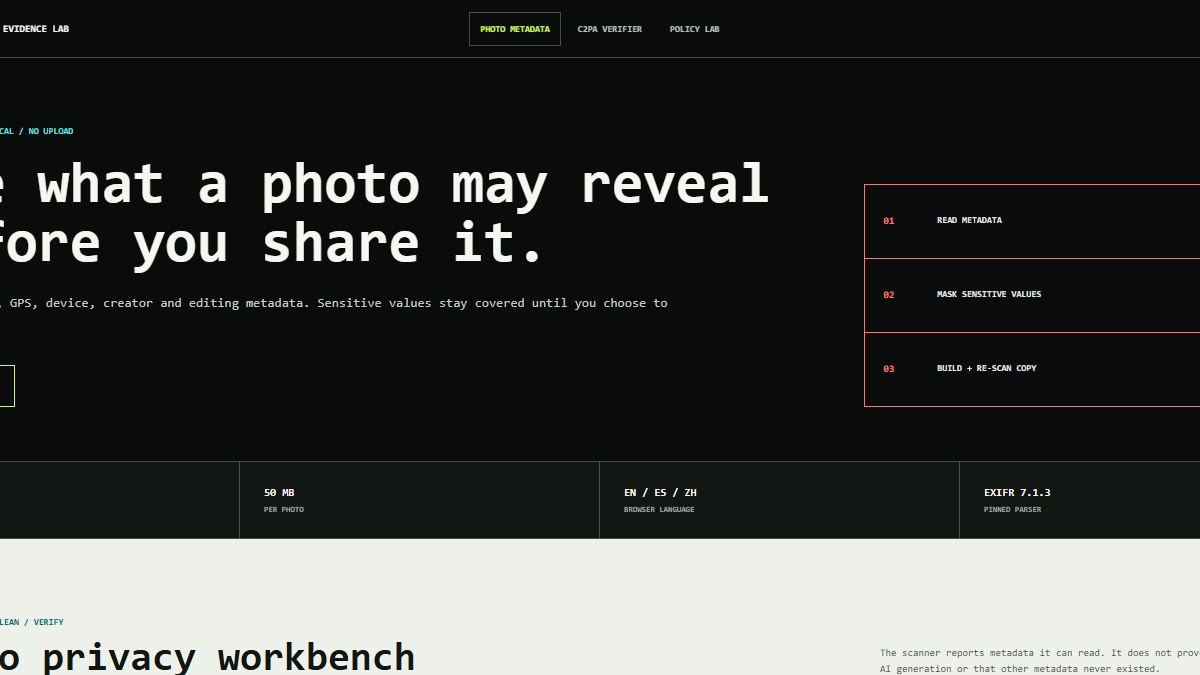
File API supplies bytes to the self-hosted parser and Web Crypto computes SHA-256. The app does not upload the original, use browser storage, or send filenames and metadata tags to analytics.
6. Sensitive values are masked first
The initial result exposes categories and counts. Revealing values is an explicit local action; filtering searches tag names and categories without transmitting a query or file content.
7. A clean copy is re-encoded
Canvas redraws the visible image into JPEG, PNG or WebP. This usually drops attached metadata, but it can change compression, pixels, color, orientation or transparency, so the original should be retained.
8. The output is scanned again
After re-encoding, the same parser compares observed counts before and after. Zero means no compatible sensitive fields were read; it does not cover every proprietary block or downstream platform.
9. EXIF and C2PA answer different questions
EXIF, XMP and IPTC are editable descriptive fields. Content Credentials can provide signed manifests, asset binding, declared actions and signer trust. Neither system is a magic truth or AI detector.
Frequently asked questions
Hogar Mas · hogarmas.net
Is the photo uploaded?
No. The file is read inside the browser. Analytics receives only aggregate fixed event IDs, never the filename, hash, GPS, camera or metadata values.
What do GPS metadata and geolocation show?
They show a location only when readable location metadata is present in the available file. No observed GPS does not prove that location was never stored or that another copy does not retain it.
Does metadata verification prove where a photo came from?
No. It reports readable file fields and their categories. Metadata can be edited, removed or added, so it does not prove origin, authorship or the truth of a scene.
Does the clean copy remove every kind of metadata?
Re-encoding usually drops blocks outside the pixels and the output is re-scanned. Every proprietary container and later modification cannot be guaranteed.
Is the clean copy pixel-identical?
No. It is re-encoded and may change compression, pixels, color profile, orientation or transparency, especially when converting to JPEG.
Can metadata prove a photo is real or AI-generated?
No. Fields are editable, and their presence or absence cannot establish authenticity or AI generation.
How is this different from Content Credentials?
This viewer inspects descriptive metadata. The separate C2PA verifier validates signed manifests, hashes, asset binding and trust within its stated limits.